Description
ABOUT THE BOOK
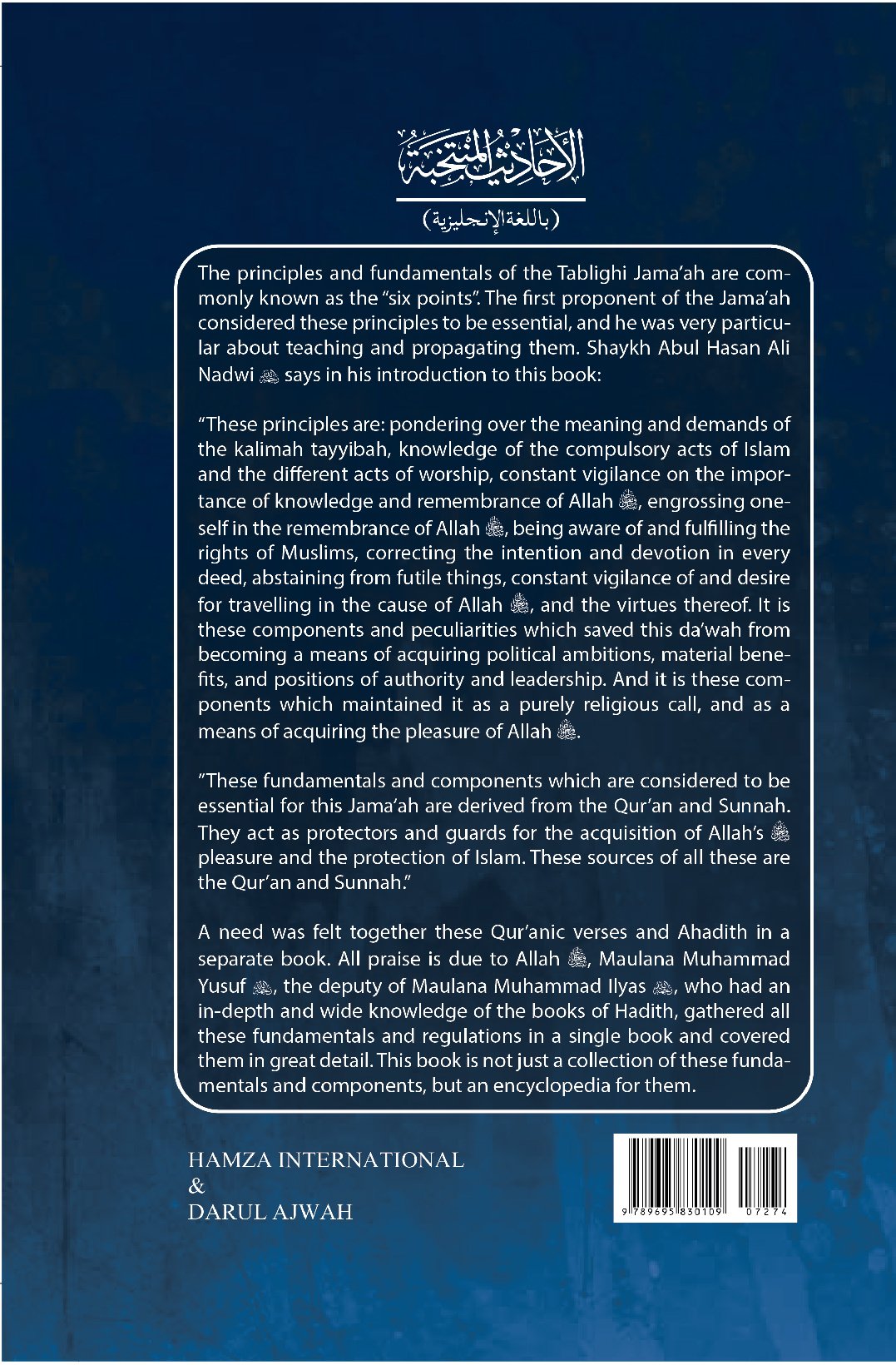
The principles and fundamentals of the Tablighi Jama’ah are com-monly known as the “six points”. The first proponent of the Jama’ah considered these principles to be essential, and he was very particu-lar about teaching and propagating them. Shaykh Abul Hasan Ali Nadwi says in his introduction to this book:
“These principles are: pondering over the meaning and demands of the kalimah tayyibah, knowledge of the compulsory acts of Islam and the different acts of worship, constant vigilance on the impor-tance of knowledge and remembrance of Allah, engrossing one-self in the remembrance of Allah, being aware of and fulfilling the rights of Muslims, correcting the intention and devotion in every deed, abstaining from futile things, constant vigilance of and desire for travelling in the cause of Allah, and the virtues thereof. It is these components and peculiarities which saved this da’wah from becoming a means of acquiring political ambitions, material bene-fits, and positions of authority and leadership. And it is these com-ponents which maintained it as a purely religious call, and as a means of acquiring the pleasure of Allah.
“These fundamentals and components which are considered to be essential for this Jama’ah are derived from the Qur’an and Sunnah. They act as protectors and guards for the acquisition of Allah’s pleasure and the protection of Islam. These sources of all these are the Qur’an and Sunnah.”
A need was felt together these Qur’anic verses and Ahadith in a separate book. All praise is due to Allah, Maulana Muhammad Yusuf, the deputy of Maulana Muhammad Ilyas, who had an in-depth and wide knowledge of the books of Hadith, gathered all these fundamentals and regulations in a single book and covered them in great detail. This book is not just a collection of these funda-mentals and components, but an encyclopedia for them
<h3 id="1">What is a return and exchange policy?</h3>
A return and exchange policy is a set of rules a retailer creates to manage how customers return and exchange unwanted merchandise they’ve purchased. These policies tell customers what items can be returned and for what reasons, as well as the timeframe over which returns are accepted.
From<a href="https://www.apple.com/shop/help/returns_refund" target="_blank" rel="nofollow noopener noreferrer"> Apple</a>’s strict 14-day return policy, to<a href="https://www.ikea.com/us/en/customer-service/returns-claims/" target="_blank" rel="nofollow noopener noreferrer"> IKEA</a>'s generous 365-day turnaround, just about every major retailer offers return and refund policies to their customers—and your small business should, too.
<h3 id="2">Why have a return policy?</h3>
A fair return and exchange policy builds trust between a business and its customers. In fact, offering a clear and consistent way for customers to return a purchased item can increase conversion and repeat rates.
Giving customers a full refund on their orders can result in a loss of profitability, and knowing that someone disliked your product can be disheartening for business owners who strongly believe in the benefits of their products and services.
For these reasons, it can be tempting to avoid creating a comprehensive return and refund policy and leave the mounting problem unaddressed. As you’ll see, however, this would be a mistake.